
The Foundations of Process Engineering
Process engineering evolved from classical chemical engineering.
- Late 19th Century: The birth of the chemical industry (soda ash, sulfuric acid, dyes) required scaling up from laboratory glassware to industrial operations. This created the need for a new profession.
- 1888: George E. Davis gives a series of lectures in Manchester, UK, which are considered the foundation of chemical engineering. He emphasized unit operations—the idea that complex chemical plants are built from a set of standardized physical operations (distillation, drying, filtration, etc.).
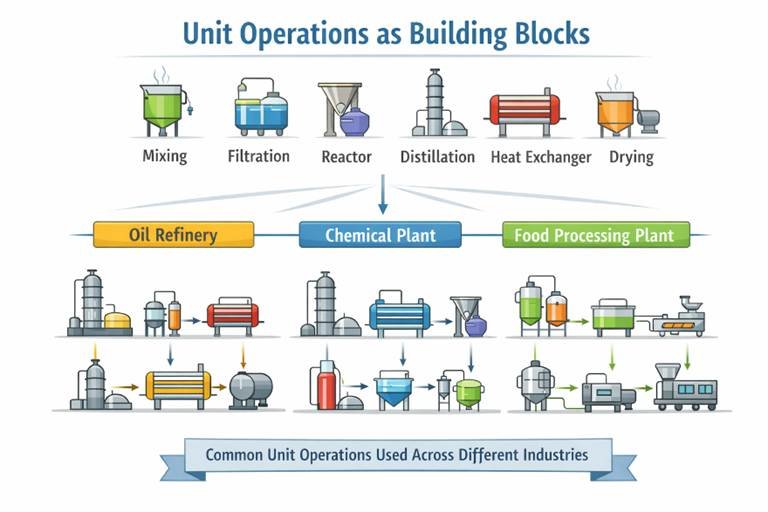
Unit Operations as Building Blocks
- Early 20th Century: The concept of “unit operations” became the central paradigm of chemical engineering education and practice (formalized by Arthur D. Little in 1915). Process engineers designed plants by linking these units together, focusing on the optimization of each individual piece of equipment.
- Mid-20th Century: The field expanded beyond chemicals to petroleum refining, petrochemicals, pharmaceuticals, and food processing. The role of the process engineer became standardized: flowsheet development, material & energy balances, equipment sizing, and economic evaluation. Optimization was largely local and sequential.
The Birth and Rise of Process Integration (1970s-1980s)
The 1970s energy crises were a major catalyst. Soaring energy costs made it economically imperative to look at the plant as a whole system, not just a collection of optimized units.
- 1971: Ed Hohmann stated in his PhD thesis that one can compute the least amount of hot and cold utilities required for a process without knowing the heat exchanger network that could accomplish it. One also can estimate the heat exchange area required
- Late 1970s: Researchers at University of Manchester Institute of Science and Technology (UMIST), notably Bodo Linnhoff, formalized and generalized these ideas into Pinch Technology or Pinch Analysis.
- Key Insight: There is a fundamental thermodynamic bottleneck (the Pinch) in any heat recovery problem. Systems should be designed to avoid “crossing the pinch,” which guarantees maximum energy recovery.
- Tools Developed: Composite Curves, Grid Diagram, Problem Table Algorithm.
- 1980s: Pinch Analysis exploded in adoption. It moved from an academic concept to a standard industrial practice for designing new plants and retrofitting existing ones. Major oil, chemical, and pharmaceutical companies adopted it, achieving energy savings of 20-50%.
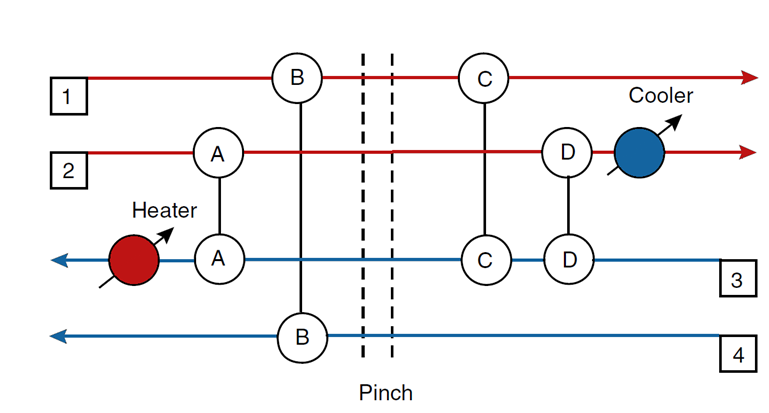
Network Diagram
- Mid-1980s Onward: The success of heat integration led to the generalization of the philosophy. Process Integration was defined as “a holistic approach to process design and optimization that emphasizes the unity of the process.”
- Mass Exchange Network (MEN) Synthesis: Analogous principles were applied to mass transfer (e.g., solvent use, water recycling).
- Hydrogen Pinch: For refinery hydrogen management.
- Power Cycle Integration: (e.g., combined heat and power, gas turbines).
Expansion and Maturity (1990s-2000s)
Process Integration matured from an energy-saving technique into a broader systems engineering discipline.
- Widening Scope: The Pinch philosophy was applied to new areas:
- Water Minimization/Water Pinch: Minimizing freshwater use and wastewater generation.
- Property Integration: Managing properties (e.g., viscosity, composition) rather than just mass/energy.
- Supply Chain & Regional Integration: Industrial symbiosis, where waste streams from one plant become feedstocks for another.
- Software Tools: Dedicated PI software became essential for complex industrial applications.
- Total Site Analysis: Extended Pinch Analysis to multiple processes served by a central utility system (e.g., a large chemical complex or refinery).
The Modern Era (2010s-Present)
Today, Process Integration is a fundamental pillar of sustainable process engineering.
- Central Role in Sustainability: PI is the core methodology for:
- Energy Efficiency & Decarbonization: Targeting minimum energy requirements is the first step toward electrification or hydrogen integration.
- Circular Economy: Designing for waste minimization, reuse, and recycling at the process and industrial park level.
- Carbon Capture and Utilization (CCU) Integration: Systematically integrating CCU technologies into industrial complexes.
- Integration with Renewable Energy: Designing flexible processes that can handle intermittent renewable energy inputs.
- Beyond Continous Processes: Application to batch process scheduling and operational flexibility.
- Methodology Fusion: PI is no longer a standalone activity. It is integrated with:
- Mathematical Programming: Combining Pinch insights with superstructure optimization for more robust and multi-objective designs.
- Process Simulation: Using rigorous simulation models to validate PI targets.
- Multi-scale Analysis: Linking molecular-level design (e.g., solvent selection) to process-level and supply-chain-level integration.
The Evolutionary Relationship
- Process Engineering is the broader parent discipline concerned with designing, operating, and optimizing processes that convert raw materials into valuable products. It provided the foundational concepts (unit operations, thermodynamics, transport phenomena).
- Process Integration is a specific, powerful methodology within process engineering. It introduced a systems-thinking paradigm shift:
- From: Sequential, local optimization of unit operations.
- To: Simultaneous, global optimization of the entire process system based on fundamental thermodynamic and practical constraints.
References
- Davis, G. E. (1901). A Handbook of Chemical Engineering
- Little, A. D. (1915). The Chemical Engineer
- Hohmann, E. C. (1971). Optimum Networks for Heat Exchange, PhD Thesis, University of Southern California
- Linnhoff, B., & Flower, J. R. (1978). Synthesis of Heat Exchanger Networks, AIChE Journal
- Linnhoff, B., et al. (1982). User Guide on Process Integration, IChemE
- Smith, R. (2005). Chemical Process Design and Integration, Wiley